According to SBI Ecowrap, every $10/barrel increase in oil price results in additional import bill of $8 billion.

The trade deficit is now at $21 billion.

"Indian business is ready to face the brave new world of globalisation. China is an important part of that brave new world. We must engage China and learn to both compete and cooperate," Singh, who began a three-day maiden visit here, said at a brainstorming session with the business delegation accompanying him, ahead of the Sino-Indian business summit on Monday.

While an official in the Commerce Department indicated a trade war was in the offing, till now the government has been in wait-and-watch mode.

'While Indian markets are indeed not inexpensive, the valuations of largecap stocks are still a considerable distance from being overstretched.'

Imports rose by 1.44 per cent to $43.44 billion in March 2019.
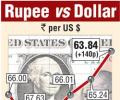
The rupee resumed higher at 64.40 a dollar from Friday's close of 65.24 and touched a low of 64.54 at the interbank foreign exchange market.
Under the scheme, also called the Export Credit Insurance Scheme, the insurance guaranteed could cover up to 90 per cent of the principal and interest.

'The cost of financing the fiscal deficit will decrease, as new passive investors join in.'

The country's exports rose by about 6 per cent to a "record" $447 billion during 2022-23 on account of healthy growth in the outbound shipments of sectors such as petroleum, pharma and chemicals and marine, Commerce and Industry Minister Piyush Goyal said on Thursday. The country's imports also grew by 16.5 per cent to $714 billion in 2022-23 as against $613 billion in 2021-22. He said that the exports of goods and services together scaled "new heights" and has increased by 14 per cent to $770 billion in 2022-23 as against 676 billion in 2021-22.

Imports dropped by a sharper pace of 7.36 per cent to $41.9 billion, signalling weakening of the economy especially with regard to fresh investments as inward shipments of plant and machinery fell by eight per cent, according to provisional data released on Thursday.

The Commerce Ministry on Friday proposed revamp of the SEZ policy to address issues concerning land acquisition and boost exports with a view to bridge the widening trade deficit.

Sharp rate hike in Russia further raised concerns about the global economy.

Non-basmati white rice accounts for nearly 25-30 per cent of total rice exported from the country.

The BSE benchmark Sensex recovered by nearly 44 points in early trade today on buying by funds and retailers amid a mixed trend in Asian region.

Country's exports continued to decline for the fifth month due to slowdown in the western economies.

Slowdown in western economies pulled down India exports for the fourth month in a row in August to 9.74 per cent, making the task of achieving $360 billion target in the current fiscal difficult.

During April-August, the shipment dipped by about six per cent to $120 billion from $127.6 billion in the same period last year, Commerce Secretary S R Rao told reporters in New Delhi.
Reflecting slowdown in the economy, imports too declined by 7.61 per cent to $37.9 billion in July, leaving a trade deficit of $15.4 billion.
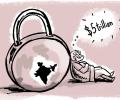
'There is a fiscal crisis building up, which might become apparent when the Finance Commission presents its report,' warns T N Ninan.

According to the data released by the Commerce Ministry on Wednesday, exports during the April-June quarter of 2012-13 fiscal dipped by 1.7 per cent to $75.2 billion, from $76.5 billion in the same period last fiscal.
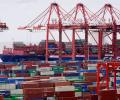
After topping it for two consecutive years, Gujarat slipped three places on the NITI Aayog's Export Preparedness Index (EPI) for 2022, as Tamil Nadu emerged as the most export-ready state, the central think tank said in its report released on Monday. In a continuing trend, coastal states were found to have the most robust export infrastructure, which officials attributed to the integration of maritime trade into the core of their economies. Maharashtra and Karnataka retained their positions -- second and third, respectively; Haryana was ranked first among landlocked states and fifth overall.

'Midcap and smallcap indices are trading in the expensive zone.'

Investors may take a 5 to 10 per cent exposure to silver. 'Have a long-term investment horizon when investing in silver ETFs to ride out short-term market fluctuations.'

Exports stood at $23.6 billion in April last year, according to data released by the Commerce Ministry in New Delhi on Friday.

In September, 2010, the country's outbound shipments were valued at $18.2 billion.

The country's apex exporters body Federation of Indian Export Organisations said that support extended by the minister for research and development activities and reduction of duties on capital goods will help in increasing competitiveness of Indian products in the global market.

The RBI, in its last policy statement, had mentioned that 'headroom for further monetary easing remains quite limited' due to risks on account of the current account, and pressures on inflation.
Imports too grew by a fast pace of 41.8 per cent.
Imports grew at a faster rate of 20.25 per cent to $40.1 billion.

Mexican President Enrique Pena Nieto's decision to cancel his planned trip to the United States next week was mutually agreed upon, US President Donald Trump has said stating that such a meeting would be "fruitless unless Mexico is going to treat America fairly".
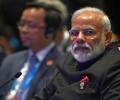
India has been forcefully raising the issue of market access as well as protected lists of goods mainly to shield its domestic market as there have been fears that the country may be flooded with cheap Chinese agricultural and industrial products once it signs the deal.

Exports had stood at $25.3 billion in December 2011.
China keeps most of its foreign reserves in the United States Government securities.

India's exports in November contracted 4.17 per cent year-on-year, for the seventh month in a row, to $22.2 billion, due to slowdown in demand in the US and European markets.

Contracting for the seventh month in a row, India's exports dipped by 15.82 per cent in June to $22.28 billion due to global slowdown and dip in crude oil prices that impacted shipments of petroleum products.

Exports were down mainly due to the demand slowdown in the US and European markets.

The Commerce Ministry earlier this week commissioned a study to assess the impact of free trade agreement with South Korea, with which India had a trade deficit of about $9 billion in 2012-13.

The sectors that exhibited major growth during the April-September, 2011, period include engineering, gems and jewellery and petroleum.

Imports, too, grew by 41.8 per cent to $38.4 billion in August, translating into a trade deficit of $14 billion during the month, as per the data.
